
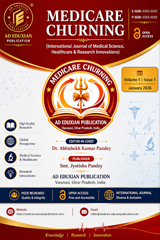
Online ISSN: 2839-500X
Content
The journal is committed to publishing high-quality, original, and ethically sound research. All submitted manuscripts undergo a rigorous evaluation process to ensure academic integrity, scholarly contribution, and adherence to global publication standards. Peer review plays a central role in maintaining the quality of published research and promoting ethical academic practices among researchers.
Peer Review Policy
All manuscripts submitted to the journal are subjected to a double-blind peer review process, ensuring that neither the authors nor the reviewers are aware of each other’s identities. This system guarantees an unbiased, fair, and objective evaluation of the research work.
The journal has an international panel of reviewers from diverse academic disciplines. This enables effective review of manuscripts across a wide range of subjects and, where feasible, different languages.
The journal strictly follows the ethical and editorial standards recommended by the Committee on Publication Ethics (COPE). Editors and reviewers are responsible for ensuring that all submitted manuscripts comply with these guidelines.
Review and Publication Process
The journal follows a structured and transparent review workflow:
1. Initial Editorial Screening
Each submitted manuscript is initially reviewed by an editor with relevant subject expertise. At this stage, the manuscript is evaluated for:
- Relevance to the journal’s scope
- Basic academic quality
- Originality and presentation
Manuscripts that do not meet the required standards may be rejected without external peer review, allowing authors to receive a prompt decision.
2. Reviewer Assignment
Manuscripts that pass the initial screening are assigned to expert reviewers based on:
- Subject specialization
- Research expertise
- Language suitability (if applicable)
3. Evaluation Criteria
Reviewers assess manuscripts based on the following parameters:
- Relevance of Title and Content
- Scholarly Quality
- Logical Flow and Continuity
- Application of Theory
- Novelty and Originality
- Technical Accuracy and Validity
- Clarity of Explanation and Illustrations
- Critical Analysis
- Quality and Relevance of References
- Strength and Clarity of Conclusions
Each criterion is evaluated systematically, and an overall score is assigned.
4. Review Outcome
Based on reviewer recommendations, the editorial decision may be:
- Accepted
- Accepted with Minor/Major Revisions
- Rejected
5. Revision Policy
If revisions are required:
- Authors must submit the revised manuscript within one month.
- Failure to resubmit within the stipulated time will result in the manuscript being treated as a new submission.
6. Acceptance Criteria
A manuscript is considered for publication only if it achieves a minimum of a 75% overall evaluation score based on reviewer assessment.
7. Final Editorial Processing
After successful peer review:
- The manuscript undergoes final editorial checks.
- Language, formatting, and technical corrections may be applied.
- The article is then approved for publication.
Plagiarism Policy
The journal enforces a strict zero-tolerance approach toward plagiarism and is committed to publishing only original research work.
Definition of Plagiarism
- Copying text without proper citation
- Paraphrasing without acknowledgment
- Use of others’ ideas, data, or findings without attribution
- Self-plagiarism or duplicate publication
Plagiarism Detection & Acceptable Threshold
All submitted manuscripts are screened using advanced plagiarism detection software such as Turnitin, which compares content against published literature, online databases, and academic repositories.
- Manuscripts with a similarity index above 20% (excluding references and properly cited content) will be rejected.
- Authors will be provided with a plagiarism report for transparency.
Ethical Responsibility
Authors Must:
- Submit original, unpublished work
- Properly cite all sources
- Comply with ethical research and publication standards
Editors and Reviewers Must:
- Ensure fairness and confidentiality
- Follow ethical guidelines
- Identify and report any ethical concerns
Commitment to Ethical Publishing
The journal is dedicated to upholding the highest standards of academic integrity. Any cases of misconduct, including plagiarism, data falsification, or unethical practices, will be handled strictly in accordance with the principles established by the Committee on Publication Ethics (COPE).


